Who Owns the Power Decision? Aligning Capital Allocators and Developers Around DER Strategy
Week 7 | DER Strategy Brief
Who Owns the Power Decision? Aligning Capital Allocators and Developers Around DER Strategy
DER Strategy Brief | Week 7
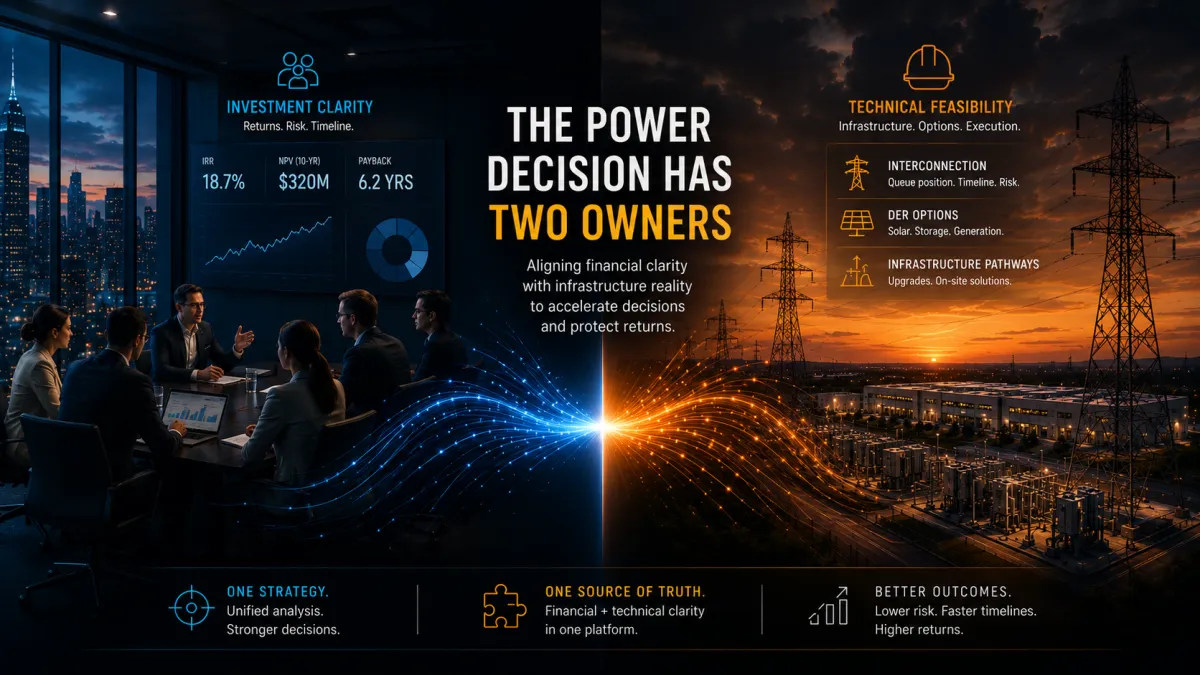
The power decision in data center development does not belong to one person.
After site preparation, it belongs to two groups who are rarely looking at the same information at the same time and that gap between them is where predevelopment stalls, timelines extend and returns erode before a single dollar of construction capital is deployed.
Capital allocators need investment-grade financial clarity before they commit. Site developers need technical feasibility answers before they can produce that clarity. Each group is waiting on the other and traditional workflows ensure neither gets what they need fast enough.
That misalignment is not a communication problem. It is an analytical one. And it has a structural solution.
Executive Brief
The power decision in data center development falls in a gap between capital allocators and site developers; two groups asking different questions about the same asset at the same time
Capital allocators require IRR confidence, NPV projections, and timeline certainty before committing; developers require technical feasibility, infrastructure validation, and DER configuration analysis before those numbers can be produced
The gap between those two needs is where predevelopment stalls; introducing delays that erode returns before construction begins
Integrated DER evaluation platforms close that gap by producing investment-grade financial outputs and technical analysis simultaneously from a single workflow
What This Article Explains
Why the power decision falls between capital allocators and site developers
How that misalignment creates delays that compound into financial consequences
What each stakeholder needs from a power strategy evaluation and how integrated DER analysis satisfies both simultaneously
How closing the decision gap upstream improves capital deployment outcomes across individual sites and entire portfolios
The Decision Gap Nobody Is Talking About
Every data center development project has two sets of questions that need to be answered before it moves forward.
The first set belongs to capital allocators. Can this site generate the returns we need within the timeline we require? What are the power costs, interconnection risks, and infrastructure assumptions that underpin the financial model? Is this an investment we can defend at committee?
The second set belongs to site developers. What power configurations are technically feasible on this site? What are the interconnection constraints, DER options, and infrastructure pathways available? What timeline can we credibly commit to?
These are not the same questions. And in traditional development workflows they are answered sequentially meaning the allocator cannot get what they need until the developer finishes, and the developer cannot start until the allocator signals intent.
The result is a circular dependency that slows everything down.
The power decision stalls not because either group is moving slowly. It stalls because both groups are waiting for information that the other group cannot yet provide.
What Capital Allocators Need From a Power Decision
For a capital allocator, the power decision is fundamentally a risk quantification exercise.
Before committing capital, an allocator needs to understand the probability that a site will reach energization within the required timeline, at the modeled cost, with the resiliency characteristics the asset requires. Power uncertainty, unresolved interconnection timelines, known and unknown utility upgrade costs, undefined DER configurations forces conservative assumptions into the financial model that inflate perceived risk even when the underlying asset is strong.
Since energy is approximately 40% of a data center’s operational costs, the effect on returns is direct and often invisible. A site with genuine power optionality, multiple viable pathways to energization including hybrid DER configurations, may be modeled as a single-pathway grid-dependent project because the DER alternatives were never evaluated. The financial model reflects the most conservative readable scenario, not the most accurate one.
Power uncertainty does not just delay decisions. It inflates the cost of capital applied to them even when that uncertainty could have been resolved with earlier analysis.
At portfolio scale the problem compounds. Allocators sequencing capital across multiple sites are making relative decisions; which site gets funded first, which gets restructured, which gets passed. Without comparable power analysis across all sites those decisions are made on incomplete information. Capital goes to the sites that were evaluated most recently or most thoroughly not necessarily the ones with the strongest returns.
What Developers Need From a Power Decision
For a site developer, the power decision is a feasibility and pathway problem.
Developers need to know which infrastructure configurations are technically viable on a given site, at what cost, and on what timeline before they can hand anything credible to an allocator. In traditional workflows that means engaging utilities, initiating interconnection studies, evaluating on-site generation options, and modeling storage configurations through sequential processes that take months to complete and may produce answers that are already outdated by the time they arrive.
The interconnection queue is the most visible constraint. But it is not the only one. Utility infrastructure upgrade requirements, load profile volatility, resiliency specifications, and emissions obligations all feed into the feasibility picture and each one has historically required separate analysis through separate workflows.
A developer working through those constraints sequentially cannot give an allocator the confidence they need until every thread has been resolved. And every thread takes time.
Traditional development workflows do not just slow the power decision. They guarantee that the developer and the allocator are never working from the same analytical picture at the same time.
Where the Gap Becomes a Financial Consequence
The decision gap between allocators and developers is not just a workflow inefficiency. It has a direct and calculable financial cost.
Every month a site spends in predevelopment limbo, with the allocator waiting for feasibility clarity and the developer waiting for capital commitment, is a month of deferred revenue. Fixed costs continue to accrue. Competing sites advance. And the assumptions embedded in the financial model age, requiring revision cycles that extend timelines further.
For a 100 MW data center generating $50-80 million in stabilized annual revenue, a three-month predevelopment delay represents $12-20 million in deferred revenue. That is not a rounding error. It is a material impact on IRR that traces directly back to the analytical gap between two groups who needed the same information at the same time and had no way to get it simultaneously.
The decision gap has a price. It is paid in deferred revenue, compressed returns, and capital that sits idle while two groups wait for each other to move first.
DER Strategy as the Bridge
Distributed Energy Resource evaluation is where the decision gap can be closed because it is the one analytical workflow that produces outputs both stakeholders need simultaneously.
When DER analysis is conducted in isolation from financial modeling, it answers the developer's feasibility question but not the allocator's investment question. When financial modeling is conducted without DER analysis, it answers the allocator's return question but only under the most conservative power assumptions available.
When both are conducted simultaneously, technical feasibility and financial modeling integrated into a single workflow, the developer and the allocator receive the same analytical output at the same time. The developer sees which configurations are viable and on what timeline. The allocator sees what those configurations mean for IRR, NPV, and capital deployment timing. Neither group is waiting on the other because neither group needs the other to finish first.
DER evaluation does not just expand infrastructure options. It closes the information gap between the people building the asset and the people funding it.
A hybrid DER configuration that bridges an interconnection delay does not just solve a technical problem for the developer. It restores timeline confidence and financial viability to the same asset at the same time giving the allocator exactly what they need to move from evaluation to commitment.
The Emissions Variable Both Groups Are Now Carrying
There is a third dimension to the power decision that is arriving faster than most development teams have built into their workflows.
Emissions liability is now a question that capital allocators and site developers are both being asked to answer from different directions and on overlapping timelines. Allocators are facing emissions scrutiny from institutional investors, capital deployment frameworks and regulators. Developers are facing emissions obligations from state-level disclosure requirements and corporate sustainability commitments embedded in their hyperscale customer contracts, as well as continued monitoring, reporting and reducing emissions over time in 13 States.
Neither group can answer their emissions question without the other's input. The developer's infrastructure configuration choices determine the emissions profile of the asset. The allocator's return requirements shape which configurations are financially viable. Without integrated emissions analysis those two inputs never meet and the emissions picture that emerges is an assumption rather than a validated output.
This is precisely the gap EmissionCheckIQ+ is built to close. The platform brings emissions analysis into the predevelopment workflow alongside power configuration and financial modeling, so both the developer and the allocator have a complete emissions picture before decisions are made and before capital is committed.
EmissionCheckIQ+ is launching. Built specifically to bring emissions clarity into the predevelopment decision where both allocators and developers need it most.
Portfolio Implications of Closing the Gap
When allocators and developers are working from the same analytical output at the portfolio-level effects are significant.
Sites that are technically viable and financially sound surface faster. Sites that cannot meet required returns under any power configuration are identified and restructured or eliminated earlier before pre-engineering spend accumulates and before capital is partially committed.
Capital sequencing decisions improve across the portfolio. Developers can demonstrate which sites have the strongest combination of power availability, DER optionality, emissions performance, and financial returns. Allocators can deploy capital toward those sites with confidence rather than with conservative assumptions that discount genuine optionality.
The development pipeline becomes more capital-efficient. Not because individual sites got better, but because the decision process that evaluates them got faster and more complete.
A portfolio where every site has been evaluated simultaneously across power configuration, financial returns, and emissions liability is not just a stronger portfolio, it is a fundamentally more defensible capital deployment strategy.
The Role of the 8X Energy Platform
The 8X Energy platform is built to close the decision gap at the source by producing the outputs both capital allocators and site developers need from a single integrated workflow.
DERLabsIQ evaluates cost, resiliency, emissions, and timing simultaneously across the full DER configuration space. Rather than producing a feasibility answer for the developer and leaving the allocator to translate it into financial terms, DERLabsIQ produces investment-grade outputs that speak directly to both stakeholders, technical configuration analysis and financial pro forma in the same workflow.
UtilityCheckIQ+ After the data center is built UtilityCheckIQ+ autonomously reviews and audits every utility invoice; gas, electric, water, other comparing historical and current tariffs in real time. It identifies overcharges, contract errors, and misapplied rates with precision.
The result: organizations see exactly where they’re losing money and what tariff options minimize cost going forward. Energy accounting becomes continuous, not reactive.EmissionCheckIQ+ brings the emissions picture into the same predevelopment workflow where power and financial decisions are already being made. Both allocators and developers leave the evaluation with a complete emissions profile not a promise to produce one later. After construction EmissionCheckIQ+ tracks, verifies, and forecasts carbon emissions automatically. It benchmarks every facility against its regulatory baseline, predicts penalties for non-compliance, and provides prescriptive actions to close the gap.
Together the three platforms do not just accelerate individual decisions. They restructure the relationship between capital allocators and site developers around shared analytical output eliminating the circular dependency that has historically defined predevelopment and replacing it with a workflow where both groups move forward together.
That is not faster analysis. It is a different kind of decision.
Unlocking Value by Closing the Gap
The power decision belongs to both capital allocators and site developers. It always has. The problem has never been that one group owns it and the other does not. The problem has been that both groups need different things from the same decision and traditional workflows have never produced both at the same time.
The organizations that close that gap, that give allocators and developers a shared analytical foundation for the power decision, will reach investment-grade clarity faster, deploy capital with greater precision, and build development pipelines that consistently outperform those still waiting for sequential analysis to resolve the same questions one at a time.
The power decision does not stall because nobody is moving. It stalls because both groups are moving in isolation. The platform that ends that isolation is where competitive advantage in data center development is now being built.
If your organization is navigating the decision gap between capital allocation and site development and the power decision is taking longer than your timeline can absorb, request early beta access or contact the 8X Energy team to explore how the 8X Energy platform closes the gap.
We are currently onboarding a limited number of early beta partners and would welcome the conversation.
Next in the Series
Look for Week 8 of the DER Strategy Brief: From Feasibility to Fundable: How Investment-Grade DER Analysis Accelerates Capital Commitment
Inside the 8X Energy Platform
Emissions analysis disconnected from power strategy is just compliance paperwork. Connected to it, it is a competitive advantage.
The 8X Energy platform integrates power configuration, utility economics, and emissions compliance into a single predevelopment decision workflow giving capital allocators and site developers the shared analytical foundation they need to move forward together.
DERLabsIQ evaluates cost, resiliency, emissions, and timing simultaneously across the full DER configuration space compressing months of sequential feasibility analysis into minutes and producing investment-grade outputs before capital is committed.
UtilityCheckIQ+ validates utility cost and tariff assumptions against real rate structures grounding financial models in verified inputs rather than estimates that require revision when they meet actual utility data.
EmissionCheckIQ+ converts energy and operational data into auditable GHG reporting and compliance forecasting bringing the emissions picture upstream into the predevelopment workflow where it has the highest leverage and the lowest cost to address.
Together the three platforms produce one integrated predevelopment analysis. Organizations move from site evaluation to investment-grade decision with every variable that affects long-term financial performance visible, quantified, and optimized simultaneously.
That is not three tools running in parallel. It is one decision, made completely.
Organizations currently evaluating data center sites, DER infrastructure, or emissions compliance obligations may benefit from early access to the 8X Energy platform.
Request Early Beta Access: Beta Program
Prefer to speak with the team: Contact Us
About 8X Energy
Welcome to 8X Energy and to the beginning of a fundamental shift in how America produces, analyzes, and deploys energy. 8X was built by operators who have allocated and executed billions in energy infrastructure across federal, healthcare, utility, and industrial markets. The platform codifies lived operational judgment into scalable software accelerating the conversion of energy intent into bankable DER projects by delivering investor-grade technical and financial outputs in minutes versus months.
External Links for Additional Resources
Visit our homepage: 8xenergy.com
Interconnection Queue Data (LBNL): emp.lbl.gov (opens in new tab)
Capital Allocator Priorities (CBRE): cbre.com (opens in new tab)
Data Centers and Power as the Gatekeeper: areadevelopment.com (opens in new tab)
