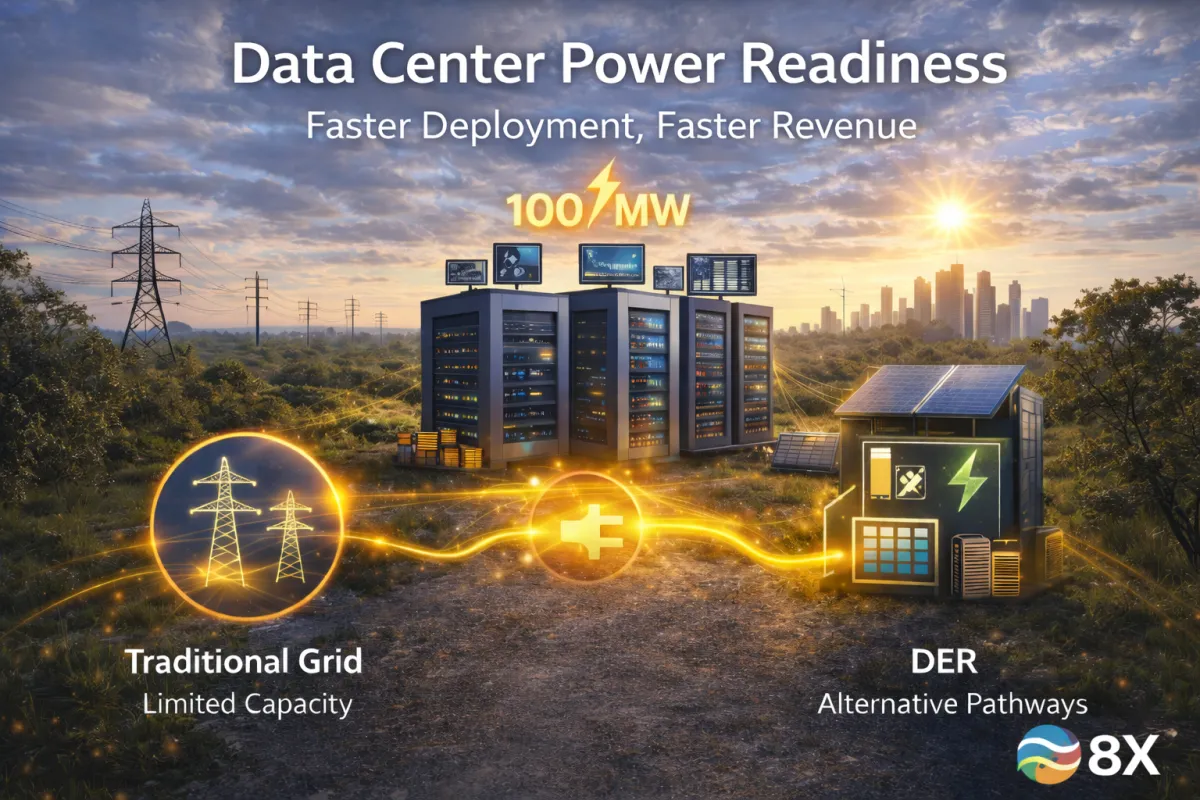
Data Center Power Readiness: Faster Deployment, Faster Revenue
Week 4 | DER Strategy Brief
Data Center Power Readiness: Faster Deployment, Faster Revenue
The speed at which a data center reaches power determines how quickly it generates revenue.
Demand for data center capacity continues to accelerate, driven by AI workloads, hyperscale expansion, and digital infrastructure growth. Capital is available. Sites are being acquired. Development pipelines are expanding.
Yet projects continue to stall or disappear from the project schedule altogether.
The constraint is not demand. It is the ability to achieve power readiness within a defined and reliable timeframe.
Executive Brief
• Data center deployment timelines are increasingly constrained by power availability and interconnection uncertainty
• Delays in power readiness directly delay revenue recognition and reduce Net Present Value (NPV)
• Early evaluation of Distributed Energy Resources (DER) creates alternative pathways to accelerate power availability
• Platforms such as DERLabsIQ compress power strategy evaluation from months to minutes, enabling developers to identify the optimal pathway to energization before capital is committedWhat this article explains
• Why power readiness has become the primary constraint in data center deployment
• How delays in energization directly impact time-to-revenue and NPV
• How DER strategies accelerate power availability and reduce dependence on grid timelines
• How faster evaluation enables better capital allocation across data center portfoliosThe Power Bottleneck in Data Center Deployment
Data center development is no longer limited by capital or demand.
It is limited by access to reliable, affordable, emission-friendly power.
In many regions, grid interconnection queues now extend three to five years, a backlog that has more than doubled over the past decade, according to Lawrence Berkeley National Laboratory’s annual interconnection queue analysis. (1) Utility infrastructure upgrades introduce cost and uncertainty that are difficult to quantify early. Queue backlogs continue to grow as more projects compete for limited capacity.
This creates a fundamental bottleneck.
Projects can secure land, complete permitting, and finalize design, yet remain unable to energize. Until power is available, revenue cannot begin.
Power readiness has become the critical path.
Power Readiness as a Revenue Variable
In data center economics, time-to-power is time-to-revenue.
Every month a facility remains unenergized is a month of deferred revenue. Lease agreements cannot be activated. Compute capacity cannot be deployed. Contracts cannot be monetized.
The financial implications are direct. A 100MW facility generating $50-80 million annually in stabilized revenue loses that revenue for every month it remains unenergized, a direct and calculable drag on NPV.
Revenue shifts forward or backward based on energization timelines. Net Present Value is impacted accordingly. Capital remains idle while fixed costs continue to accrue.
Delays are not operational inconveniences. They are financial outcomes.
Why Traditional Power Planning Slows Deployment
Traditional power planning relies heavily on utility timelines.
Developers engage utilities, initiate interconnection studies, and wait for results. Engineering, financial modeling, and infrastructure planning often follow in sequence. Each step depends on the previous one being completed.
This creates a linear process in an environment where utility timelines shift, interconnection costs change, and financial assumptions require constant revision. When inputs change, and they will, the entire sequence must restart.
Distributed Energy Resources as a Power Acceleration Layer
Distributed Energy Resources (DER) provide a different path.
Rather than relying exclusively on grid interconnection, developers can evaluate on-site generation, battery storage, microgrids, and hybrid configurations earlier in the process.
DER does not replace the grid. It expands the available pathways to power readiness. In practice, this means a site facing a three-year interconnection queue can deploy on-site generation and storage to begin operating at partial capacity while grid interconnection proceeds in parallel, preserving the development timeline without abandoning the grid altogether.
This introduces optionality.
A site constrained by grid timelines may become viable through a hybrid approach. On-site generation can bridge interconnection delays. Storage can optimize load profiles and reduce dependency on peak grid capacity.
Power becomes a design variable, not a fixed constraint.
Financial Impact: Faster Power, Faster Revenue
The financial implications of accelerated power readiness are significant.
Advancing energization by even a few months can materially increase revenue recognition. That same 100 MW facility, advanced by just 90 days, captures $12-20 million in revenue that would otherwise be deferred, a direct NPV improvement before a single optimization is made.
The relationship is straightforward.
Earlier power availability leads to earlier revenue. Earlier revenue improves Net Present Value.
At portfolio scale, the effect compounds.
Multiple sites reaching power readiness sooner accelerate overall capital deployment, improve utilization, and enhance returns across the investment portfolio.
Time delay is value erosion.
The Role of DERLabsIQ in Power Strategy
The ability to evaluate power strategies quickly is critical.
Platforms such as DERLabsIQ enable developers to model multiple power configurations, including grid, DER, and hybrid approaches, in minutes rather than months. By integrating technical feasibility with financial modeling, DERLabsIQ allows organizations to identify optimal pathways to power readiness earlier in the development cycle.
This changes how decisions are made.
Instead of waiting for sequential studies, developers can explore multiple scenarios simultaneously. They can compare timelines, costs, and financial outcomes before committing capital.
The result is faster, more informed decision-making.
From Site-Level Constraints to Portfolio-Level Advantage
Power readiness challenges do not exist in isolation.
Organizations developing multiple data centers must allocate capital across competing sites, each with different power constraints, timelines, and economic profiles. Delays at one site do not stay contained, they absorb management attention, hold capital in place, and reduce flexibility across the entire pipeline.
Faster evaluation changes portfolio dynamics. Developers can identify which sites have the strongest combination of power availability, financial returns, and deployment timelines, and sequence capital accordingly. A site that reaches power readiness three months earlier than alternatives is not just a better individual asset; it is a reallocation opportunity.
At scale, that sequencing precision becomes a repeatable competitive advantage.
Reducing Risk Through Early Power Strategy
Power uncertainty introduces development risk.
The earlier that risk is reduced, the more efficient capital deployment becomes.
By evaluating power strategies early, including DER alternatives, developers can move from assumption to validated analysis sooner. They can avoid committing capital to sites that cannot meet required timelines or returns.
Speed is not just efficiency. It is risk reduction.
Unlocking Value Through Power Readiness
Data center infrastructure is increasingly defined by its ability to access power.
As demand continues to grow, the organizations that reach power readiness faster will capture disproportionate value. They will deploy capital sooner, activate revenue earlier, and operate with greater confidence.
Power is no longer just an input. It is a determinant of financial performance.
8XEnergy builds the decision intelligence layer that compresses power strategy evaluation and the ability to make decisions from months to minutes. DERLabsIQ integrates DER analysis, technical feasibility, and financial modeling into a single workflow, so developers can move from site identification to investment-grade decision faster, with greater confidence, and with less capital at risk.
If your organization is evaluating data center sites or managing a development pipeline, request early beta access or contact the 8X Energy team to explore how DERLabsIQ accelerates your path to power readiness.
Next in the Series
Look for Week 5 in our 12-part DER Strategy Brief: Beyond Power Readiness: Why Emissions Liability is the Next Variable in Data Center Investment
Inside DERLabsIQ
DERLabsIQ is an AI-driven analytics platform designed to accelerate the evaluation and deployment of distributed energy resources.
By combining technical feasibility modeling with investment-grade financial analysis, the platform helps organizations move from early project evaluation to informed infrastructure investment decisions significantly faster than traditional feasibility processes.
Organizations currently evaluating distributed generation, battery storage, microgrid deployment, or DER portfolio investments may benefit from early access.
Request Early Beta Access
We are currently onboarding a limited number of early beta partners interested in evaluating DER opportunities with greater analytical speed and financial transparency.
Request early beta access →
Beta Program (opens in new tab)
Prefer to Speak With the 8X Energy Team?
Contact our team →
About 8X Energy
Welcome to 8X Energy and to the beginning of a fundamental shift in how America produces, analyzes, and deploys energy. 8X was built by operators who have allocated and executed billions in energy infrastructure across federal, healthcare, utility, and industrial markets. The platform codifies lived operational judgment into scalable software accelerating the conversion of energy intent into bankable DER projects by delivering investor-grade technical and financial outputs in minutes vs months. This is not generic AI. It is domain-constrained intelligence built to justify capital where the stakes are highest.
DERLabsIQ™ — Infrastructure Decision Intelligence
DERLabsIQ automates 30% conceptual DER design, optimizing across cost, resiliency, emissions, and timing in minutes instead of months. Tradeoffs become explicit, quantified, and auditable; not embedded in subjective engineering judgment. What once required extended feasibility studies and significant upfront spend is produced near-instantaneously at dramatically lower cost. Outputs include site-specific DER configurations, financial pro formas, emissions modeling, resiliency metrics, and code-compliant engineering diagrams. DERLabsIQ becomes the system of record for energy decisions where assumptions, tradeoffs, and outcomes persist over time.
A Unified Decision Platform
DERLabsIQ is supported by:
UtilityCheckIQ+™— utility and tariff intelligence validating billing assumptions and forecast accuracy
EmissionCheckIQ+™— emissions and compliance intelligence embedded upstream in decision logic
Together, they form a single decision authority for distributed energy planning.
Why 8X
Decisions made before engineering begins
Faster capital deployment with lower risk
Persistent institutional memory and defensibility
High-margin software anchored to infrastructure-scale spend
NPV risk mitigation
External Links for Additional Resources
Visit our homepage: 8xenergy.com (opens in new tab)
(1) Lawrence Berkeley National Laboratory - Queued Up: Characteristics of Power Plants Seeking Transmission Interconnection: emp.lbl (opens in new tab)
Queued Up: emp.lbl(opens in new tab)
AI Data Center Growth:Meeting the Demand McKinsey.com(opens in new tab)
Generational AI Growth, data centers and the upcoming US power demand surge: goldmansachs.com(opens in new tab)
