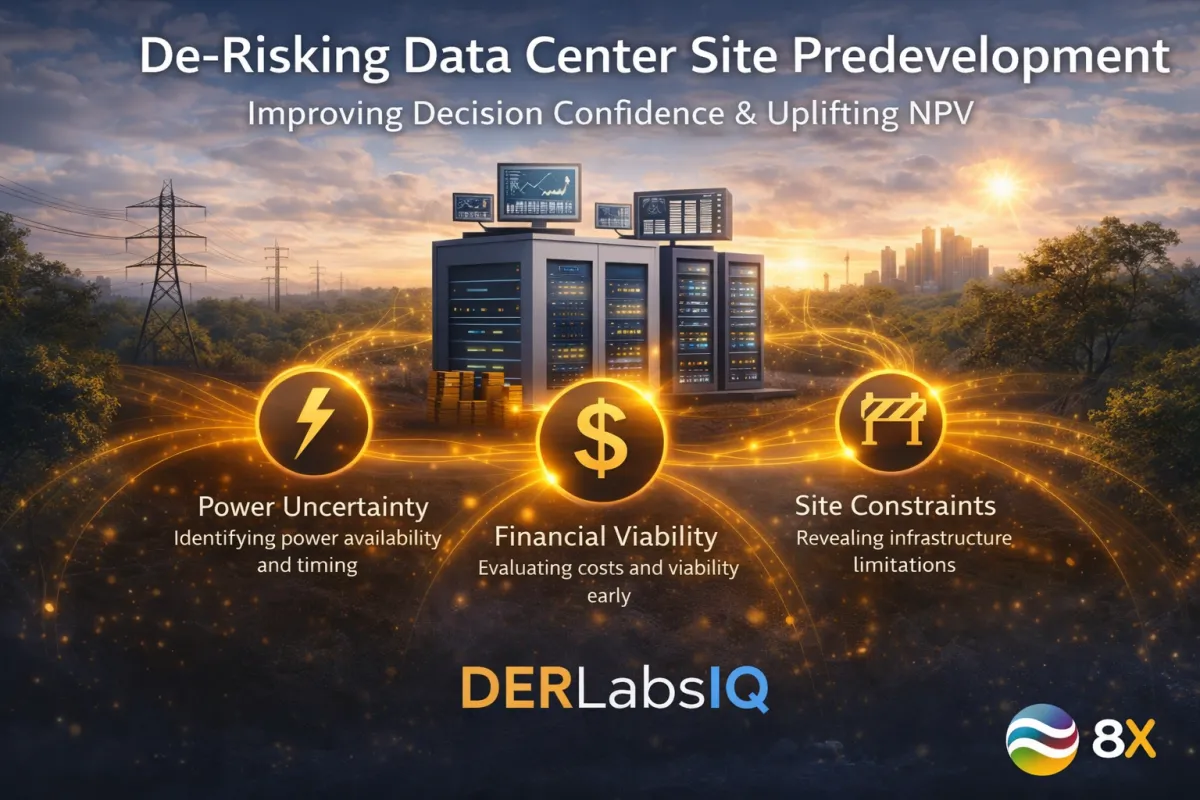
De-risking Data Center Predevelopment: How DER evaluation improves NPV
Week 3 | DER Strategy Brief
De-Risking Data Center Predevelopment: How DER Evaluation Improves NPV.
The earliest decisions in data center development determine whether value is created or destroyed.
Data center demand is accelerating faster than infrastructure can support. Hyperscale expansion, AI workloads, and digital growth are driving unprecedented site acquisition activity.
Yet many projects stall before they ever reach construction.
The constraint is not demand. It is power and financial uncertainty concentrated at the start of development.
Executive Brief
Data center predevelopment carries hidden financial risk driven by power availability and infrastructure constraints
Misaligned early-stage assumptions can materially reduce Net Present Value (NPV)
Early visibility into power feasibility, financial viability, and site constraints reduces risk before capital is committed
Integrated DER and financial modeling platforms compress 6–12 month feasibility cycles into days, reducing pre-engineering spend and protecting IRR
What this article explains
Why data center site predevelopment risk is driven primarily by power availability and infrastructure uncertainty
How early-stage DER evaluation improves visibility into financial viability, timelines, and site constraints
Why faster decision-making reduces predevelopment risk and protects Net Present Value (NPV)
How integrated decision intelligence platforms compress feasibility timelines and improve capital deployment outcomes
Stay Ahead of the DER Transition
Receive the weekly DER Strategy Brief, a 12-part series exploring capital deployment, infrastructure finance, and distributed energy resource economics.
Subscribe to receive each article as it is released.
Subscribe to DER Strategy Brief (opens in new tab)
The Hidden Risk in Data Center Site Predevelopment
Data center development risk is front-loaded.
Before a site is energized, before tenants are secured, and before revenue begins, capital is committed based on assumptions. Power availability, interconnection timelines, infrastructure costs, and financial viability are all estimated with limited precision at the moment decisions need to be made.
These early assumptions determine whether a project moves forward.
If they are wrong, the consequences are significant. Delays extend timelines. Costs increase. Incentives may be forfeited. Revenue is deferred. In some cases, projects are abandoned after substantial capital has already been deployed.
The risk is not always visible. It is embedded in the gap between site selection and financial clarity and grows more expensive over time.
Power Availability as the Primary Constraint
For most data center projects, power is the gating factor.
Grid interconnection timelines in many markets now extend two to four years. Utility capacity may be constrained. Required infrastructure upgrades introduce cost and schedule uncertainty that is difficult to quantify early. In regions with significant queue backlogs, determining when power will be available with financing-level confidence is difficult.
Land acquisition, permitting, engineering, and debt or equity financing decisions all depend on the ability to energize the site within a defined window. Without that window, capital deployment becomes speculative rather than strategic.
Power readiness is not just an operational milestone. It is a financial prerequisite, and the projects that reach it with confidence, earlier, are the ones that perform.
Why Traditional Predevelopment Analysis Falls Short
Traditional data center site evaluation relies on fragmented, sequential workflows.
Engineering assessments, utility engagement, financial modeling, and infrastructure planning are typically conducted in series. Financial projections are built before interconnection costs are known. Each handoff introduces delay, and each new input requires revising the assumptions that preceded it.
Traditional workflows rely on fragmented, sequential analysis across engineering, utility, and financial teams. Each step introduces delay, and each new input requires revisiting prior assumptions.
In practice, this means a developer might spend three to six months on preliminary studies, only to reach investment committee with key inputs still unresolved. Power timelines may have shifted. Utility upgrade costs may have come in higher than expected. The financial model may need to be rebuilt.
The result is slower decision-making, increased holding costs, and capital tied up in projects that may not meet required return thresholds once the picture is complete.
Distributed Energy Resources as a De-Risking Strategy
Distributed Energy Resources (DER), including on-site generation, battery storage, microgrids, and hybrid grid configurations, introduce a fundamentally different approach to power readiness.
Rather than relying solely on grid interconnection, DER enables alternative and hybrid pathways to power readiness.
By incorporating DER into early-stage analysis, developers can move from a binary question, is grid power available on the timeline we need? to a more productive one: what is the optimal combination of grid and on-site resources to achieve power readiness within our financial constraints?
That shift changes how risk is managed.
A site that appears constrained from a grid-only perspective may be viable through a hybrid configuration that bridges the interconnection gap. A site with favorable on-site generation potential may support a faster timeline and better cost structure than one that is fully grid dependent. Understanding these trade-offs early is where DER creates financial value.
Earlier DER evaluation enables:
Realistic timelines to power readiness across multiple infrastructure scenarios
Cost trade-offs between grid interconnection, on-site generation, and hybrid configurations
Revenue timing implications of each pathway
Capital efficiency across site alternatives at the portfolio level
This shifts the conversation from uncertainty to optionality, and optionality, in capital-intensive infrastructure development, is what protects returns.
Financial Impact: What Earlier Clarity Is Actually Worth
When risk is reduced early, financial outcomes improve.
Consider the NPV mechanics directly. A 100 MW data center facility generating $50–80 million annually in revenue creates significant value for each month that operations are advanced or deferred. A six-month delay in predevelopment, caused by unresolved power assumptions, a utility study that required revision, or a financial model rebuilt after new interconnection cost data arrived, can represent tens of millions of dollars in deferred revenue on a single asset.
Uncertainty in early-stage analysis increases discount rates applied to projected returns. Misaligned assumptions push projects through multiple revision cycles before capital is committed. Incentive structures; tax credits, utility programs, state-level incentives, may be time-sensitive and lost when timelines extend.
Conversely, reaching financial and infrastructure clarity faster compresses timelines, reduces pre-engineering spend, and allows capital to be deployed with greater confidence. IRR is protected not by optimizing the financial model, but by reducing the time and risk that sit upstream of it.
Top-performing developers move from site identification to investment-grade decision faster and with fewer revisions. They are the ones that move from site identification to investment-grade decision faster than the competition and make fewer costly corrections along the way.
From Site-Level Risk to Portfolio-Level Strategy
For organizations developing multiple data centers, the implications extend well beyond any individual project.
Predevelopment risk accumulates across a portfolio. When multiple sites are evaluated simultaneously, delays and uncertainty at the site level affect capital allocation decisions across the entire pipeline. Capital committed to a project that later stalls is capital unavailable for a higher-confidence opportunity.
Faster, more accurate site evaluation changes portfolio management in concrete ways. Developers can identify which sites are most viable earlier, which require alternative infrastructure strategies, and where capital should be sequenced first. Eliminating or restructuring sites earlier materially improves capital efficiency.
This is where the case for better predevelopment analysis moves beyond individual project optimization and becomes a portfolio-level strategic advantage.
The Role of Decision Intelligence Platforms in Early-Stage Evaluation
Decision intelligence platforms now integrate DER analysis, technical feasibility, and financial modeling into a unified workflow.
Rather than conducting sequential studies across separate teams and timelines, these platforms allow developers to explore multiple site configurations, infrastructure pathways, and financial scenarios simultaneously, reaching a higher-confidence decision point weeks or months earlier than traditional workflows allow.
The most capable platforms are compressing what was historically a 6–12 month predevelopment feasibility cycle into days, with pre-engineering spend reductions of 60–80% compared to conventional approaches. That compression directly protects IRR by reducing the time between site identification and capital deployment, and eliminates resources spent on projects that would have failed later in the process.
DERLabsIQ is an example of this category, built specifically to integrate DER analysis with financial modeling for infrastructure developers who need to move quickly without sacrificing analytical rigor.
Reducing Uncertainty Before Capital Is Committed
The most effective way to manage predevelopment risk is to reduce it before it materializes.
In data center development, that means reaching financial and infrastructure clarity as early as possible, understanding power availability, realistic cost structures, and deployment timelines before major capital is committed. It means treating the predevelopment phase not as a prerequisite to be completed, but as the phase where the most value is either created or destroyed.
The projects that perform do not simply have better assets. They have better information, earlier.
Unlocking Value Through Early Clarity
Data center infrastructure is capital-intensive, time-sensitive, and increasingly competitive at the site acquisition and predevelopment stage.
The difference between successful projects and underperforming ones often lies in decisions made long before construction begins. Organizations that can identify constraints, evaluate DER alternatives, and align financial structures early are better positioned to capture value, and better protected from the compounding cost of uncertainty.
As demand for digital infrastructure continues to accelerate, the ability to de-risk predevelopment will become a defining competitive advantage. The combination of distributed energy resource strategy and integrated decision intelligence platforms is shortening the path from site identification to investment-grade commitment.
In a market where every month of delay has a calculable cost, earlier clarity is financial leverage.
Next in the Series
Look for Week 4 in our 12-part DER Strategy Brief: Data Center Power Readiness: Faster Deployment, Faster Revenue
Inside DERLabsIQ
DERLabsIQ is an AI-driven analytics platform designed to accelerate the evaluation and deployment of distributed energy resources.
By combining technical feasibility modeling with investment-grade financial analysis, the platform helps organizations move from early project evaluation to informed infrastructure investment decisions significantly faster than traditional feasibility processes.
Organizations currently evaluating distributed generation, battery storage, microgrid deployment, or DER portfolio investments may benefit from early access.
Request Early Beta Access
We are currently onboarding a limited number of early beta partners interested in evaluating DER opportunities with greater analytical speed and financial transparency.
Request early beta access →
Beta Program (opens in new tab)
Prefer to Speak With the 8X Energy Team?
Contact our team →
About 8X Energy
Welcome to 8X Energy and to the beginning of a fundamental shift in how America produces, analyzes, and deploys energy. 8X was built by operators who have allocated and executed billions in energy infrastructure across federal, healthcare, utility, and industrial markets. The platform codifies lived operational judgment into scalable software accelerating the conversion of energy intent into bankable DER projects by delivering investor-grade technical and financial outputs in minutes vs months. This is not generic AI. It is domain-constrained intelligence built to justify capital where the stakes are highest.
DERLabsIQ™ — Infrastructure Decision Intelligence
DERLabsIQ automates 30% conceptual DER design, optimizing across cost, resiliency, emissions, and timing in minutes instead of months. Tradeoffs become explicit, quantified, and auditable; not embedded in subjective engineering judgment. What once required extended feasibility studies and significant upfront spend is produced near-instantaneously at dramatically lower cost. Outputs include site-specific DER configurations, financial pro formas, emissions modeling, resiliency metrics, and code-compliant engineering diagrams. DERLabsIQ becomes the system of record for energy decisions where assumptions, tradeoffs, and outcomes persist over time.
A Unified Decision Platform
DERLabsIQ is supported by:
UtilityCheckIQ+™— utility and tariff intelligence validating billing assumptions and forecast accuracy
EmissionCheckIQ+™— emissions and compliance intelligence embedded upstream in decision logic
Together, they form a single decision authority for distributed energy planning.
Why 8X
Decisions made before engineering begins
Faster capital deployment with lower risk
Persistent institutional memory and defensibility
High-margin software anchored to infrastructure-scale spend
NPV risk mitigation
External Links for Additional Resources
Visit our homepage: 8xenergy.com (opens in new tab)
Energy Demand from AI: iea.org (opens in new tab)
Powering Intelligence: epri.com(opens in new tab)
Evaluating Increase in Electricity Demand from Data Centers: energy.gov(opens in new tab)
