DER Optimization Software: Eliminating the Cost vs Resiliency Tradeoff
Week 5 | DER Strategy Brief
DER Optimization Software: Eliminating the Cost vs. Resiliency Tradeoff
For decades, distributed energy resource design has forced a choice.
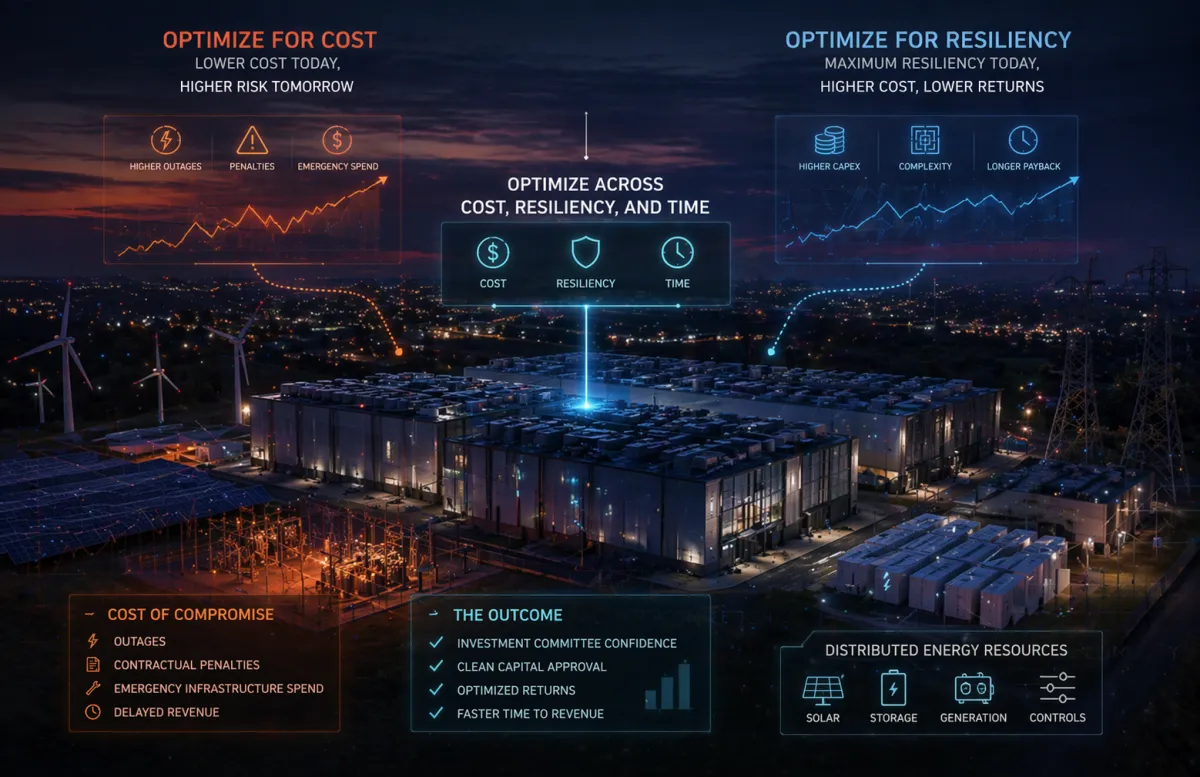
Organizations evaluating on-site generation, battery storage, and microgrid configurations have faced a consistent tension: optimize for cost, and resiliency suffers. Optimize for resiliency, and cost structures become difficult to justify. Optimize for GHG emissions, and resiliency and cost structures become stranded costs. The tradeoff has been treated as a permanent feature of the decision landscape, something to be managed, not eliminated.
It is not permanent. It is a product of how decisions have been made.
Executive Brief
The perceived tradeoff between cost, emissions, and resiliency in DER design is a function of analytical limitations, not physical constraints
Traditional DER evaluation optimizes for one variable at a time, forcing sequential tradeoffs that compound across the development cycle
Modern DER optimization software evaluates cost, resiliency, emissions, and timing simultaneously, producing configurations that perform across all dimensions rather than sacrificing one for another
Organizations that eliminate the tradeoff at the evaluation stage deploy capital with greater confidence, protect IRR, and reach investment-grade decisions faster
What This Article Explains
Why the cost vs. resiliency tradeoff exists and where it originates in the evaluation process
How traditional DER design methodology perpetuates the tradeoff rather than resolving it
How DER optimization software reframes the decision from sequential compromise to simultaneous optimization
How eliminating the tradeoff upstream improves capital deployment outcomes and financial performance
The Origin of the Tradeoff
The cost vs. resiliency vs. emissions profile tension in DER design does not begin with the technology.
It begins with the analysis.
Traditional DER evaluation is built around sequential optimization, engineers assess load requirements, model a generation configuration, evaluate cost, then adjust for resiliency requirements, then re-evaluate cost. Each pass through the analysis introduces new constraints that require the previous work to be revised.
The result is a process that rarely reaches a true optimum. It reaches a negotiated position, a configuration where one variable has been prioritized, and others have been compressed to fit.
The tradeoff is not inherent to the technology. It is an artifact of how the technology is evaluated.
How Traditional Methodology Perpetuates the Problem
When DER design is conducted sequentially, the first variable modeled effectively anchors the decision.
If cost is modeled first, resiliency requirements are layered on top of a cost-optimized configuration. The result is a system that was designed to be inexpensive and then modified to be resilient, rarely the same as a system designed to be both from the outset.
If resiliency is modeled first, cost is treated as a constraint rather than a design input. The system meets resilience targets, but the cost structure may not survive investment committee scrutiny without significant revision.
Either path produces the same outcome: a design that has been optimized for one dimension and compromised on others, with the gap between what was modeled and what was needed embedded invisibly in the project assumptions.
In data center development, where power reliability is non-negotiable and cost structures determine whether projects meet return thresholds, this gap is not acceptable.
Sequential optimization does not resolve the cost vs. resiliency tradeoff. It delays it.
Simultaneous Optimization: What DER Software Changes
DER optimization software reframes the problem entirely.
Rather than modeling variables in sequence, modern platforms evaluate cost, resiliency, emissions, material availability, and timing simultaneously across millions of potential configurations. Constraints are inputs, not afterthoughts. Trade-off surfaces become visible before any configuration is selected, and the analysis produces not a single negotiated answer but a range of optimized options, each with a fully quantified cost, resiliency, and emissions profile.
This changes what is possible at the decision stage.
A data center developer evaluating a 100 MW campus can model every viable combination of on-site generation, battery storage, grid interconnection, and hybrid microgrid configuration, and understand the financial and operational implications of each, before committing to a design path. The question shifts from "which variable do we sacrifice" to "which configuration best satisfies all of our constraints simultaneously?"
That shift is not incremental. It is structural.
Financial Impact: What the Tradeoff Was Actually Costing
The cost vs. resiliency tradeoff has always carried a financial consequence that was difficult to quantify because it was embedded in assumptions rather than visible in outputs.
When resiliency is under-engineered to control upfront costs, the exposure surfaces later, in unplanned outages, contractual penalties, emergency infrastructure spend, and the reputational cost of reliability failures at critical facilities. For data centers operating under uptime SLAs, the financial consequence of a single resiliency gap can exceed the capital that was saved by accepting the tradeoff in the first place.
When cost is deprioritized to meet resiliency targets, projects face a different problem: configurations that are technically sound but financially unjustifiable, requiring redesign cycles that extend timelines and erode returns before construction begins.
Both paths have a cost. The tradeoff was never free; it was just deferred.
Eliminating the tradeoff at the evaluation stage removes both exposures simultaneously. Organizations reach investment-grade decisions with configurations that are cost-justified and operationally sound, without the revision cycles that fragment timelines and compress returns.
Application in Data Center Development
In data center infrastructure, the cost vs. resiliency tradeoff carries unusually high stakes.
Uptime requirements are contractual. Power reliability is a commercial prerequisite. And the capital intensity of the asset class means that resiliency gaps identified late in development are expensive to correct, and resiliency over-engineering that inflates cost structures can make otherwise viable sites uneconomic.
DER optimization software allows data center developers to evaluate the full configuration space, grid-only, hybrid, microgrid, and on-site generation combinations, with explicit resiliency and cost outputs for each pathway. Sites that appear constrained from a grid-only resiliency perspective may prove viable through a hybrid configuration that meets uptime requirements at a lower capital cost than a fully islanded approach.
The analysis surfaces these pathways before capital is committed.
Earlier identification of the optimal configuration compresses the predevelopment cycle, reduces pre-engineering spend, and protects IRR by eliminating the revision loops that occur when resiliency gaps are discovered after a design has been financially modeled.
Portfolio-Level Implications
At portfolio scale, the compounding effect of resolving the cost vs. resiliency tradeoff earlier becomes significant.
Organizations developing multiple data center sites simultaneously are not evaluating one configuration. They are making capital allocation decisions across competing sites, each with different resiliency requirements, power constraints, and cost profiles. When the tradeoff is resolved sequentially at each site, the analytical burden multiplies and the risk of misaligned assumptions compounds.
DER optimization software allows portfolio-level analysis to proceed with consistent, comparable outputs across all sites. Capital can be sequenced toward the configurations with the strongest combination of cost efficiency and resiliency performance, not the ones that happened to be evaluated first or modeled with the most favorable assumptions.
A portfolio where every site has been evaluated simultaneously across cost and resiliency is a fundamentally different, and more defensible, capital deployment strategy.
The Role of DERLabsIQ
DERLabsIQ is built to eliminate the sequential optimization problem at the source.
The platform evaluates cost, resiliency, emissions, and timing simultaneously across the full DER configuration space, producing investment-grade outputs that do not require the developer to select one variable for optimization at the expense of others. Configurations are ranked and compared with full financial, operational, and emissions transparency, so the decision-maker sees not just what is optimal but why.
For data center developers, this means reaching a fully optimized design pathway, one that satisfies resiliency requirements and cost thresholds simultaneously, in minutes rather than the weeks or months that sequential feasibility studies require.
UtilityCheckIQ+ validates the utility cost and tariff assumptions that underpin the financial model. EmissionCheckIQ+ embeds compliance and emissions logic upstream, so the optimized configuration carries a complete regulatory and emissions profile before capital is committed.
Together, they produce a decision that is optimized across every dimension that matters, cost, resiliency, emissions, and timing, in a single integrated workflow.
Reducing Risk at the Design Stage
The cost vs. resiliency tradeoff has historically been treated as a risk management problem, something to be hedged, insured against, or accepted.
It is more precisely a decision quality problem.
When the analysis produces a fully optimized configuration, the risk embedded in the tradeoff does not need to be managed. It has been removed. Organizations that reach this level of analytical clarity earlier in the development cycle deploy capital with greater confidence, commit to fewer revision cycles, and arrive at investment committee with outputs that are defensible across every dimension of the decision.
Speed is not just efficiency. It is risk reduction. And earlier clarity is financial leverage.
Unlocking Value Through Optimized DER Design
The cost vs. resiliency vs. emissions tradeoff has shaped how distributed energy infrastructure has been planned and evaluated for decades. It has constrained what developers believe is achievable and introduced a persistent source of risk into capital-intensive projects where design compromises surface as financial consequences.
DER optimization software eliminates the structural cause of the tradeoff, not by accepting the tension, but by resolving it computationally before the design is fixed and before capital is committed.
The organizations that adopt this approach will deploy capital more efficiently, reach investment-grade decisions faster, and build distributed energy portfolios that perform across cost, resiliency, and emissions without the compromises that sequential evaluation requires.
8X Energy builds the decision intelligence layer that makes simultaneous optimization possible. DERLabsIQ integrates cost, resiliency, emissions, and timing analysis into a single workflow, so developers can move from site identification to optimized, investment-grade design faster, with greater confidence, and with less capital at risk.
If your organization is evaluating data center sites or distributed energy infrastructure and the cost vs. resiliency tradeoff is shaping your decisions, request early beta access or contact the 8X Energy team to explore how DERLabsIQ eliminates the tradeoff at the source.
Next in the Series
Look for Week 6 of the DER Strategy Brief: The Other Side of the Power Decision: Why Emissions Liability Is the Next Capital Risk in Data Center Development
Inside DERLabsIQ
DERLabsIQ is an AI-driven analytics platform designed to accelerate the evaluation and deployment of distributed energy resources.
By combining technical feasibility modeling with investment-grade financial analysis, the platform helps organizations move from early project evaluation to informed infrastructure investment decisions significantly faster than traditional feasibility processes.
Organizations currently evaluating distributed generation, battery storage, microgrid deployment, or DER portfolio investments may benefit from early access.
Request Early Beta Access
We are currently onboarding a limited number of early beta partners interested in evaluating DER opportunities with greater analytical speed and financial transparency.
Prefer to Speak With the 8X Energy Team?
About 8X Energy
Welcome to 8X Energy — and to the beginning of a fundamental shift in how America produces, analyzes, and deploys energy. 8X was built by operators who have allocated and executed billions in energy infrastructure across federal, healthcare, utility, and industrial markets. The platform codifies lived operational judgment into scalable software — accelerating the conversion of energy intent into bankable DER projects by delivering investor-grade technical and financial outputs in minutes versus months.
External Links for Additional Resources
Visit our homepage: 8xenergy.com
National Bureau of Economic Research: nber.org (opens in new tab)
Energy and AI: iea.org (opens in new tab)
Regulatory Climate Shift: corpgov.law.harvard.edu (opens in new tab)
