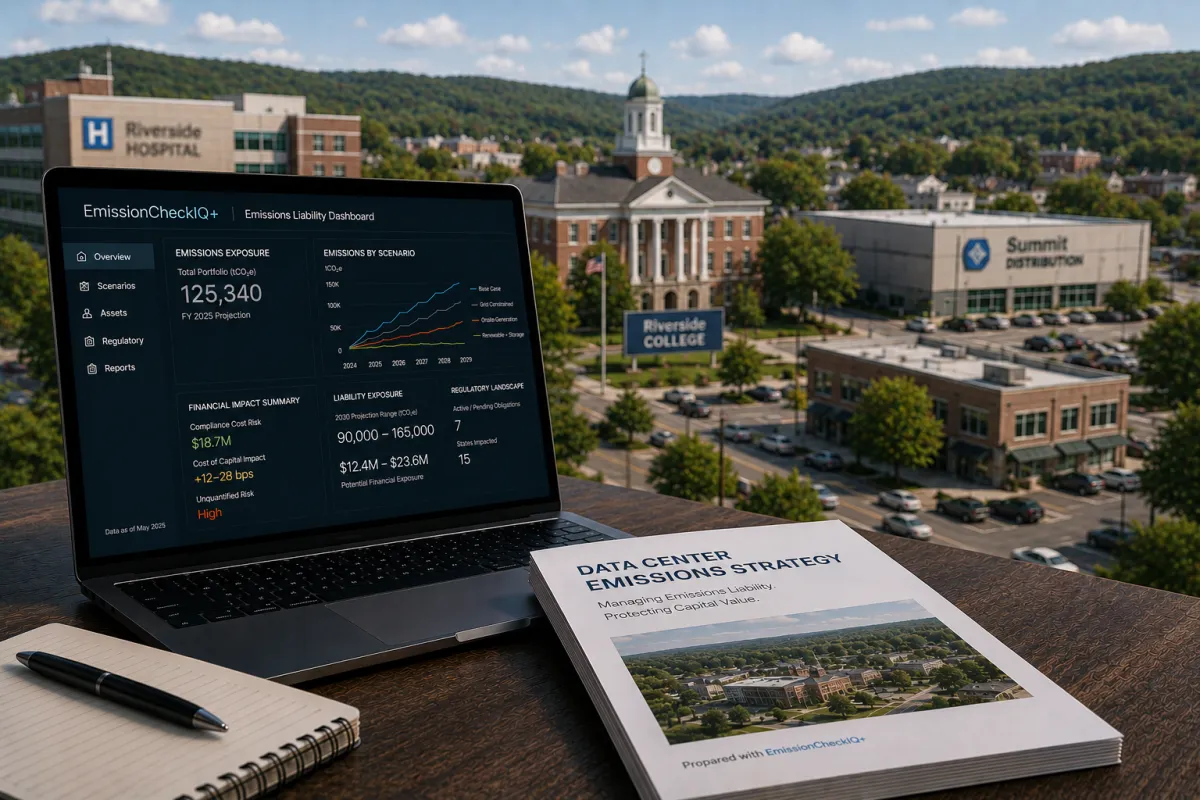
The Other Side of the Power Decision: Why Emissions Liability is the Next Capital Risk in Data Center Development
Week 6 | DER Strategy Brief
The Other Side of the Power Decision: Why Emissions Liability Is the Next Capital Risk
The data center industry has spent years solving the power problem.
Interconnection queues, grid constraints, and the race to energization have dominated the development conversation. Capital has been deployed, infrastructure has been built, and entire platforms have been developed to compress the time between site identification and power readiness.
That work is not finished. But a second problem is now arriving alongside it.
Emissions liability is becoming a capital risk in data center development. Not eventually. Now. And the organizations that treat it as a future compliance concern rather than a present financial variable are already behind.
Executive Brief
·Emissions liability in data center development is transitioning from a sustainability reporting function to a capital allocation variable — and the transition is happening faster than most developers have priced in
·Mandatory emissions disclosure legislation is active or advancing in multiple states simultaneously, institutional investors are embedding emissions criteria into capital deployment frameworks, and hyperscale operators are pushing emissions accountability into their supply chains — creating overlapping obligations that exist independent of any single regulation
·Emissions exposure that is unquantified at the predevelopment stage introduces risk into financial models that cannot be priced, hedged, or managed until it is visible
·Organizations that embed emissions analysis upstream — before capital is committed — convert an unquantified liability into a managed variable and protect returns across the full investment horizon
What This Article Explains
·Why emissions liability is moving from compliance teams to investment committees
·How unquantified emissions exposure affects financial models and capital allocation decisions
·What the current national regulatory landscape means for data center developers and infrastructure capital allocators
·How upstream emissions analysis changes the risk profile of data center investments
The Problem With Treating Emissions as a Downstream Function
For most of the past decade, emissions management in data center development has followed a predictable pattern.
A project is identified, evaluated, designed, financed, and built. Somewhere downstream, after the asset is operational, an emissions report gets produced. It goes to a sustainability team or a compliance function. It satisfies a reporting requirement. And it has no meaningful connection to the capital allocation decisions that determined the asset's structure.
That pattern made sense when emissions reporting was voluntary, when regulatory timelines were distant, and when investment committees were not asking emissions questions.
None of those conditions still apply.
Emissions liability that is invisible at the decision stage does not disappear. It accumulates and surfaces later as a capital risk that was never priced into the original investment.
What Has Changed
Three things have shifted simultaneously, and the combination is what makes this urgent.
Regulation has a timeline and it is not a single law in a single state. Mandatory emissions disclosure legislation is active or advancing in multiple major states simultaneously, with compliance deadlines beginning in 2026. The organizations caught by these requirements are not defined by where they are headquartered, they are defined by where they do business and how much revenue they generate. For data center developers and capital allocators operating at any meaningful scale, that scope is broad.
Capital allocators are asking the question. ESG disclosure requirements, institutional investor mandates, and the increasing scrutiny of infrastructure assets on emissions grounds mean that investment committees are now evaluating emissions exposure as part of the underwriting conversation not as a separate sustainability review. An asset with unquantified emissions liability carries a risk premium that a clean asset does not. That premium affects cost of capital and return projections whether or not it is explicitly priced.
Data centers are among the highest-scrutiny assets in the infrastructure market. U.S. data centers currently account for more than four percent of total national electricity consumption, with 56 percent derived from fossil fuels, generating over 105 million tons of CO2 equivalent annually. As AI workloads continue to drive demand growth that figure will increase. The combination of scale, fossil fuel dependency, and accelerating demand makes data center emissions a specific and growing focus of regulatory and investor attention across the country.
The conditions that allowed emissions to be treated as a downstream function no longer exist.
How Emissions Liability Enters the Financial Model
When emissions exposure is unquantified at the predevelopment stage, it does not stay invisible. It enters the financial model as an assumption, typically an optimistic one, and the gap between that assumption and eventual reality becomes a source of return erosion.
The mechanism is direct.
Compliance costs that were not modeled compress margins after the asset is operational. Retrofit requirements that were not anticipated increase capital expenditure against a budget that was set without them. Disclosure obligations that require third-party assurance introduce audit costs and timeline risk that were not factored into the development plan.
Each of these is a financial consequence of an emissions decision that was deferred rather than made.
The question is not whether emissions liability will affect the financial model. It is whether that effect will be visible and managed, or invisible and discovered.
The Predevelopment Window Is When It Matters Most
Emissions analysis has the highest leverage when it happens earliest.
At the predevelopment stage, configuration decisions have not been made. Infrastructure choices that determine the emissions profile of an asset for its entire operating life are still open. An on-site generation mix that includes a higher proportion of clean sources costs the same to evaluate as one built entirely on fossil fuel generation but the difference in long-term emissions liability and regulatory exposure is substantial.
Once those decisions are made and capital is committed, the opportunity to optimize the emissions profile diminishes sharply. Retrofitting an operational asset to meet compliance requirements is materially more expensive than designing compliance in from the outset.
The cost of solving a problem at the design stage is a fraction of the cost of solving it after the asset is built.
Earlier emissions analysis does not just reduce compliance risk. It protects the investment thesis before it is too late to change it.
What This Means for Capital Allocators
For organizations allocating capital into data center infrastructure, emissions liability introduces a specific and increasingly material risk variable.
An asset with clear, quantified emissions exposure and a credible compliance pathway carries a different risk profile than one where emissions have not been evaluated. The former can be underwritten with precision. The latter requires conservative assumptions that compress projected returns even when the underlying asset is strong.
At portfolio scale the effect compounds. Organizations developing multiple data center sites are making capital sequencing decisions across assets with different power configurations, different grid dependencies, and therefore different emissions profiles. Without upstream emissions analysis those differences are invisible, and capital gets allocated without the information needed to sequence it optimally.
Emissions clarity at the predevelopment stage is not just a compliance input. It is an underwriting input.
The Regulatory Landscape Is a National Movement, Not a State Issue
Emissions disclosure is no longer a regional conversation. It is a national capital market conversation being driven simultaneously from multiple directions.
At the state level the movement is accelerating. Mandatory emissions disclosure legislation is active or advancing across multiple major states, with compliance deadlines beginning in 2026. The threshold for applicability in these frameworks is defined by revenue and commercial activity not headquarters location. Organizations doing business at scale in the markets where data center demand is concentrated are inside the scope of these requirements whether or not they have evaluated their exposure.
At the institutional investor level, the pressure is independent of any single regulation. Major infrastructure funds, pension funds, and asset managers have embedded emissions disclosure criteria into their capital deployment frameworks. An asset that cannot produce a credible emissions picture does not fail a compliance test, it fails an underwriting conversation. That is a different and more immediate consequence than a regulatory penalty.
At the corporate level, the hyperscale operators that anchor data center demand have made public sustainability commitments that include supply chain emissions accountability. That accountability reaches the developers, operators, and infrastructure providers that serve them creating a contractual and commercial emissions obligation that exists entirely outside the regulatory framework.
The question for data center developers and capital allocators is not which regulation applies to them. It is whether their emissions exposure is quantified and manageable before any of these forces require it to be.
Unlocking Value Through Emissions Clarity
The data center industry solved the demand problem. Capital is available. Sites are being acquired. Development pipelines are expanding.
The power problem is being solved. DER strategies, hybrid configurations, and faster evaluation platforms are compressing the time between site identification and energization.
The emissions problem is next. And unlike the power problem, which arrived gradually over years of interconnection queue growth, the emissions problem has a regulatory deadline, an investor mandate, and a market expectation that are all converging at the same time.
The organizations that recognize emissions liability as a capital risk now and build the analytical infrastructure to manage it upstream will deploy capital with greater confidence, underwrite assets with greater precision, and operate with less regulatory exposure across the full investment horizon.
EmissionCheckIQ+ is built for that moment. It integrates emissions analysis, compliance forecasting, and GHG reporting into the predevelopment workflow so developers and capital allocators can move from site evaluation to investment-grade decision with the complete picture, not just the part that was easy to quantify.
If your organization is evaluating data center infrastructure and emissions liability is a variable you have not yet built into your predevelopment process, request early beta access or contact the 8X Energy team to explore how EmissionCheckIQ+ brings emissions clarity upstream.
Inside the 8X Energy Platform
Emissions analysis disconnected from power strategy is just compliance paperwork. Connected to it, is a competitive advantage.
Solving the emissions liability problem in data center development requires more than a reporting tool.
The 8X Energy platform is built to do exactly that.
DERLabsIQ evaluates cost, resiliency, emissions, and timing simultaneously across the full DER configuration space. Because the power configuration of a data center directly determines its emissions profile, optimizing for power readiness and optimizing for emissions exposure are not separate decisions they are the same decision made at the same time. DERLabsIQ compresses that evaluation from months to minutes, enabling developers to identify the optimal pathway to energization and emissions performance before capital is committed.
UtilityCheckIQ+ validates the utility cost and tariff assumptions that underpin the financial model. For organizations evaluating a shift in generation mix to reduce long-term emissions liability, utility cost validation determines whether the cleaner configuration is financially viable not just technically possible.
EmissionCheckIQ+ brings the emissions picture into focus. The platform converts energy and operational data into auditable GHG reporting and compliance forecasting, quantifying emissions exposure across active national regulatory frameworks before configuration decisions are made and before capital is committed.
Together the three platforms produce an integrated predevelopment analysis; power configuration, utility economics, and emissions compliance in a single decision workflow. Organizations move from site evaluation to investment-grade decision with every variable that affects long-term financial performance visible, quantified, and optimized simultaneously.
That is not three tools running in parallel. It is one decision, made completely.
Organizations currently evaluating data center sites, DER infrastructure, or emissions compliance obligations may benefit from early access to the 8X Energy platform.
Request Early Beta Access: Beta Program
Prefer to speak with the team: Contact Us
Next in the Series
Look for Week 7 of the DER Strategy Brief: Who Owns the Power Decision? Aligning Capital Allocators and Developers Around DER Strategy
About 8X Energy
Welcome to 8X Energy and to the beginning of a fundamental shift in how America produces, analyzes, and deploys energy. 8X was built by operators who have allocated and executed billions in energy infrastructure across federal, healthcare, utility, and industrial markets. The platform codifies lived operational judgment into scalable software — accelerating the conversion of energy intent into bankable DER projects by delivering investor-grade technical and financial outputs in minutes versus months.
External Links for Additional Resources
Visit our homepage: 8xenergy.com
Measuring the Impact of Data Centers in the United States Economy: nber.org (opens in new tab)
US Companies Face Potential GHG Disclosure Obligations 2026: corpgov.law.harvard.edu (opens in new tab)
Energy and AI: iea.org (opens in new tab)
