Why Capital Deployment Speed Determines NPV
Week 1| DER Strategy Brief
How distributed energy resources modeling speed directly impacts capital deployment, underwriting velocity, and net present value in modern infrastructure portfolios.
Executive Brief
• DER assets are now financeable infrastructure with measurable cash flows
• Yet deployment still lags available capital
• The bottleneck is not technology or financing. It is underwriting speed
What this article explains
• Why traditional DER modeling slows capital deployment
• How underwriting velocity directly affects net present value
• Why faster DER intelligence will become a competitive advantage for infrastructure investors
Stay Ahead of the DER Transition
Receive the weekly DER Strategy Brief, a 12-part series exploring capital deployment, infrastructure finance, and distributed energy resource economics.
Subscribe to receive each article as it is released.
Subscribe to DER Strategy Brief (opens in new tab)
Distributed energy resources modeling has crossed a demand threshold.
Solar generation, battery storage, microgrids, gas fired generation, fuel cells, linear generation, demand response, and behind-the-meter systems are no longer experimental technologies waiting for market acceptance.
They are financeable infrastructure assets with measurable cash flows, defined risk profiles, multiple financial levers, and increasingly sophisticated portfolio applications.
Yet despite unprecedented capital availability targeting cost/resiliency/climate-aligned infrastructure, DER deployment continues to lag the opportunity in front of it.
The constraint is not capital. It is underwriting velocity.
The Real Bottleneck in Distributed Energy Resources Modeling and DER Finance
Institutional investors, infrastructure funds, and fintech platforms are entering the distributed energy resources market with genuine conviction, and with the recent P.E. backed acquisition of AES, nearly unlimited cash. Climate-focused allocations are expanding. Electrification mandates are accelerating load growth projections. Policy incentives at the federal and state level are creating durable tailwinds.
And still, DER projects stall.
The reason is structural. Traditional distributed energy resources modeling and feasibility studies were designed for engineering validation, not capital allocation efficiency. They depend on months of data gathering, consultant modeling, iterative scenario testing, and static financial outputs that often reach investment committees long after initial conditions have changed.
By the time a DER opportunity clears internal review, load forecasts may have shifted, equipment pricing may have moved, and policy incentives may have been revised. Time does not simply delay value. It erodes it.
How Distributed Energy Resources Modeling Speed Affects Net Present Value
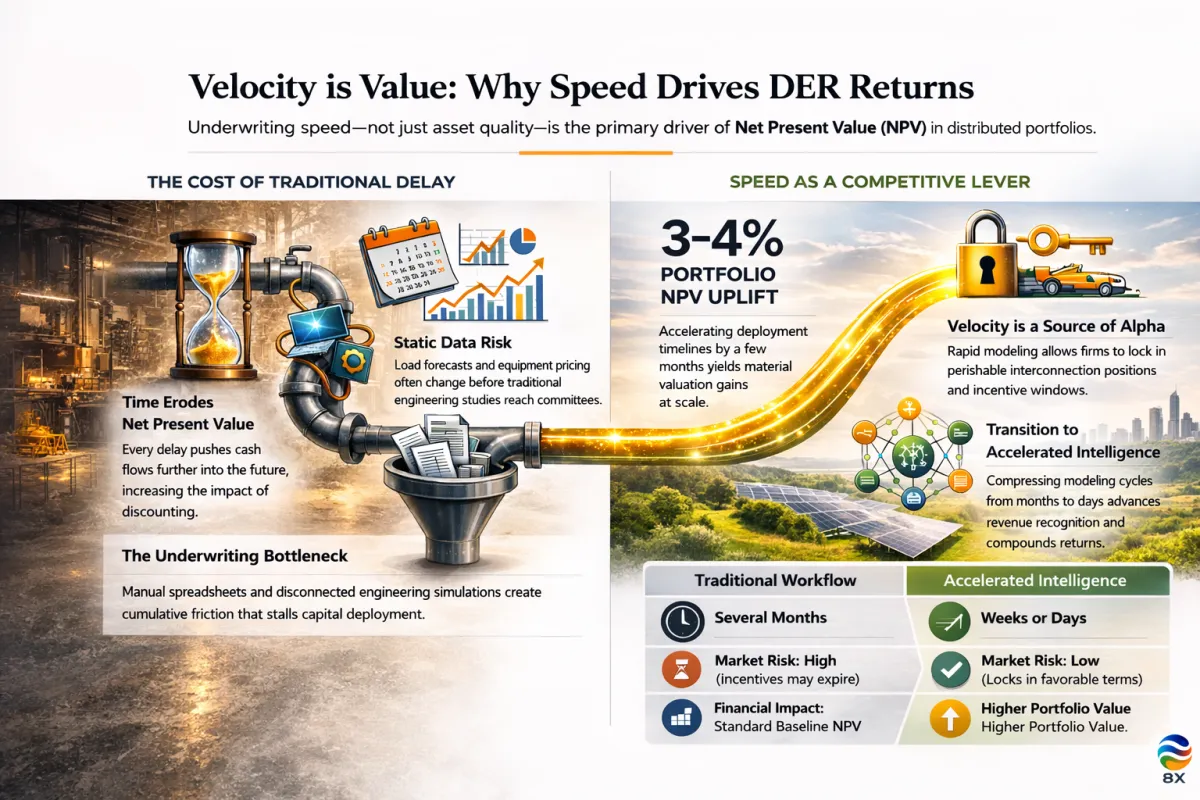
Net present value is acutely sensitive to timing. Every delay in DER deployment pushes projected cash flows further into the future, and discounting mechanics do the rest. When revenue recognition shifts by six months or a year, NPV declines an average of 300-400bps without any change in the underlying technology, site conditions, or off-take assumptions.
The math is unforgiving at scale. A distributed energy resources project projected to generate consistent revenues over fifteen years produces a certain NPV under current assumptions. Delay that project by twelve months, and those revenues are discounted further. The asset loses value before a single generating asset is installed or a single battery cycles.
Multiply that effect across a portfolio of distributed energy resources projects and the aggregate impact becomes material. Accelerating DER deployment timelines by even a few months can yield NPV uplifts in the range of three to four percent compared to traditional modeling cycles. For a single project, the gain may appear modest. At portfolio scale, it becomes a genuine valuation lever.
Platforms such as DERLabsIQ, which integrate engineering, tariff analysis, and financial modeling into a single workflow, demonstrate how accelerating distributed energy resources modeling can translate directly into measurable NPV uplift.
Capital Deployment Speed as Competitive Advantage in DER Investment
Infrastructure investing has historically treated speed as an operational metric rather than a financial one. In distributed energy resources that framing no longer holds.
DER assets exist within competitive environments that reward early movers in concrete, quantifiable ways. Interconnection queues are long and positions are perishable. Incentive programs operate on defined enrollment windows. Equipment procurement pricing fluctuates with supply chain conditions. Utility tariff structures evolve through regulatory proceedings that do not pause for slow underwriting cycles.
Organizations that can model, evaluate, and approve distributed energy resources investments quickly capture advantages that slower competitors simply cannot recover. They lock in incentive structures at favorable terms. They deploy capital before procurement windows close. They begin generating savings or revenue earlier, compounding returns across the investment horizon.
When you evaluate 100% of opportunities in minutes instead of months, underwriting velocity becomes a portfolio-level alpha engine.
Why Traditional DER Modeling Slows Capital Deployment
Most distributed energy resources modeling workflows were not designed with investment committee timelines in mind. Engineering simulations run in specialized platforms. Financial projections live in spreadsheets. Risk analysis tends to be qualitative and narrative rather than quantified and scenario ranked. Comparing alternatives requires manual recalculation at each step.
The friction this creates is cumulative. Each revised assumption requires additional consultant hours. Each new variable triggers a new modeling cycle. Each iteration extends the diligence timeline, which in turn delays capital deployment and delays the onset of cash flows.
Investment committees require clarity. They require transparent sensitivity analysis and defensible assumptions that can withstand scrutiny. When the tools available to underwriters cannot deliver that efficiently, the process slows to match the tools.
Emerging analytical tools such as DERLabsIQ, together with modules like UtilityCheckIQ+ and EmissionCheckIQ+, illustrate how integrating tariff intelligence, emissions analysis, and financial modeling into a single workflow can dramatically reduce DER underwriting friction.
The Shift Toward Accelerated DER Intelligence and Financial Optimization
As distributed energy resources mature as an asset class, the analytical expectations surrounding distributed energy resources modeling are rising commensurately.
Investment committees evaluating DER opportunities are increasingly looking for simultaneous technical and financial optimization, transparent scenario ranking, quantified tradeoffs between cost, tax depreciation, credit allocation, partnership flip, emissions reductions, and grid resiliency, rapid iteration under changing market inputs, and outputs auditable enough to satisfy institutional review standards.
Other asset classes offer instructive precedent. Commercial real estate adopted digital underwriting platforms that compressed approval timelines and increased transaction velocity. Fintech transformed consumer and commercial credit risk assessment through structured scoring systems that replaced manual review cycles. Infrastructure lending followed similar patterns as standardized models reduced diligence friction.
Distributed energy resources are approaching the same inflection point. The question is not whether analytical tools for DER will improve. It is which market participants will build workflows around faster intelligence, and which will continue to rely on processes designed for a slower era.
The Financial Implication of DER Modeling Speed for Fintech and Infrastructure Investors
For platforms and funds deploying capital into distributed energy resources, the strategic question has evolved. The case for DER as an asset class is well established. The question now is how efficiently that capital can move through the underwriting and deployment cycle in accordance with my charter.
When distributed energy resources modeling cycles compress from months to weeks or days, capital deployment accelerates. When deployment accelerates, revenue recognition advances. When revenue recognition advances, net present value improves, at an average of 300-400 bps. At portfolio scale, a few percentage points of NPV uplift across a meaningful allocation of distributed energy resources assets can shift enterprise-level returns in ways that are difficult to achieve through asset selection alone.
In competitive infrastructure markets, those marginal gains compound. They separate managers who optimize the full investment cycle from those who optimize only for asset quality.
Integrated DER analytics platforms such as DERLabsIQ illustrate how distributed energy resources analysis can compress underwriting timelines while improving transparency across financial, tariff, and emissions assumptions.
Distributed Energy Resources Modeling and the Next Phase of Capital Efficiency
Distributed energy resources are entering a phase in which analytical speed will define competitive positioning as much as deal sourcing or asset selection. Electrification, grid modernization, resiliency requirements, and the ongoing energy transition are expanding the investable universe. At the same time, institutional capital is demanding greater analytical transparency and faster decision cycles.
The firms that align technical modeling with financial intelligence will deploy capital more effectively into DER. They will secure incentives earlier, reduce idle capital time, and capture incremental net present value that slower competitors leave on the table.
Distributed energy resources are not constrained by technology readiness. The technology has arrived. They are constrained by decision velocity.
In modern infrastructure finance, velocity compounds.
Next in the Series
Look for Week 2 in our 12-part DER Strategy Brief: "DER Financial Levers: Applying Distributed Energy Resource Financial Levers to Maximize NPV".
Inside DERLabsIQ
DERLabsIQ is an AI-driven analytics platform designed to accelerate the evaluation and deployment of distributed energy resources.
By combining technical feasibility modeling with investment-grade financial analysis, the platform helps organizations move from early project evaluation to informed infrastructure investment decisions significantly faster than traditional feasibility processes.
Organizations currently evaluating distributed generation, battery storage, microgrid deployment, or DER portfolio investments may benefit from early access.
Request Early Beta Access
We are currently onboarding a limited number of early beta partners interested in evaluating DER opportunities with greater analytical speed and financial transparency.
Request early beta access →
Beta Program (opens in new tab)
Prefer to Speak With the 8X Energy Team?
Contact our team →
About 8X Energy
Welcome to 8X Energy and to the beginning of a fundamental shift in how America produces, analyzes, and deploys energy. 8X was built by operators who have allocated and executed billions in energy infrastructure across federal, healthcare, utility, and industrial markets. The platform codifies lived operational judgment into scalable software accelerating the conversion of energy intent into bankable DER projects by delivering investor-grade technical and financial outputs in minutes vs months. This is not generic AI. It is domain-constrained intelligence built to justify capital where the stakes are highest.
DERLabsIQ™ — Infrastructure Decision Intelligence
DERLabsIQ automates 30% conceptual DER design, optimizing across cost, resiliency, emissions, and timing in minutes instead of months. Tradeoffs become explicit, quantified, and auditable; not embedded in subjective engineering judgment. What once required extended feasibility studies and significant upfront spend is produced near-instantaneously at dramatically lower cost. Outputs include site-specific DER configurations, financial pro formas, emissions modeling, resiliency metrics, and code-compliant engineering diagrams. DERLabsIQ becomes the system of record for energy decisions where assumptions, tradeoffs, and outcomes persist over time.
A Unified Decision Platform
DERLabsIQ is supported by:
UtilityCheckIQ+™— utility and tariff intelligence validating billing assumptions and forecast accuracy
EmissionCheckIQ+™— emissions and compliance intelligence embedded upstream in decision logic
Together, they form a single decision authority for distributed energy planning.
Why 8X
Decisions made before engineering begins
Faster capital deployment with lower risk
Persistent institutional memory and defensibility
High-margin software anchored to infrastructure-scale spend
NPV risk mitigation
External Links for Additional Resources
Visit our homepage: 8xenergy.com (opens in new tab)
EPA: Environmental Impacts (opens in new tab)
Maximizing the Net Present Value of a Project Under Uncertainty: sciencedirect.com(opens in new tab)
The Net Present Value Criterion: PMI.org(opens in new tab)
Inspired Economist, Net Present Value: inspiredeconomist.com (opens in new tab)
